Blue Effect
Interview


At FORVIA, we frame everything through the lens of sustainability, guided by the belief that mobility is essential to people’s lives and must remain accessible to all. While many companies focus on “using better,” we quickly recognized that this approach often increases costs—putting pressure on vehicle prices and limiting access to mobility. For a company committed to safe, sustainable and affordable mobility, that approach simply wasn’t enough. Instead, we choose to use less: less material, less weight, and less energy. By reducing our overall footprint rather than increasing complexity or cost, we can advance sustainability while keeping mobility within reach for everyone.
We started with our own plants. From the good energy practices coming from our plants, we have defined the 9 energy management pillars and included them in our FORVIA Excellence System.
Every FORVIA site worked to comply with the 9 pillars. Governance, metering, optimizing baseload, recovering heat & cold, optimizing compressed air, ventilation and lighting system, without forgetting to cut drastically our fossil fuel energy consumption. Energy champions were appointed at every plant to drive local reduction targets and report progress against Group objectives.
From this strong energy governance, our energy intensity has improved by 33% and fossil fuel consumption has been cut by 53% in 2025 compared with the 2019 baseline. By improving energy efficiency and switching to renewable electricity, our Scope 1 & 2 emissions were reduced by 91%, allowing us to exceed the first milestone in our net zero journey (-80% Scope 1 & 2 emissions by 2025)
The savings generated from using less energy in our plants helped to finance the cost of electricity decarbonation — solar panels installations on site, wind turbines power purchase agreements, and Energy Attribute Certificates which are covering 92% of our electricity consumption in 2025.
Vehicles have been getting heavier for years. Electrification adds battery weight. Consumers want spacious vehicles. Safety requirements demand stronger structures and additional equipment. The modern cockpit — infotainment screens, connectivity systems, ambient lighting, thermal and acoustic comfort features — adds mass and energy consumption at every turn.
The goal is to deliver everything the modern vehicle demands while using significantly less material and energy. To do this, FORVIA is striving to implement an eco-design approach so that less goes in from the start. The discipline of using less, proven first in its own plants, became the principle FORVIA then applied to everything it engineers and builds. Weight and sustainability targets need to be embedded into every program from the earliest stage of development, because product design is where the largest gains are made — and where the window to act is narrowest.
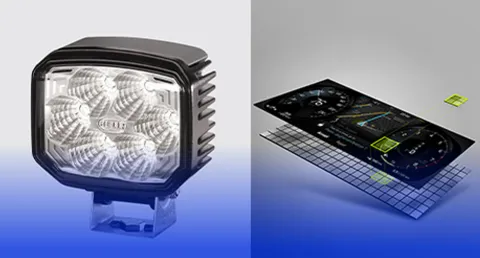
A lighter component requires less raw material to produce, generates less waste in manufacturing, and puts less demand on transport. Material substitution is one of the most direct routes. The HELLA Power Beam work lamp, for example, replaces aluminium die-cast housing with a corrosion-resistant plastic, cutting component weight by 45% and CO₂ emissions by 30%. Once the vehicle is on the road, a lighter car requires less energy to move, whether powered by petrol, diesel, or battery power. One kilogram avoided can reduce emissions by between 6 and 16 kilograms of CO₂ over a product's lifetime, lowering running costs for the driver and benefiting the environment every day the vehicle is in use.
Another strong engineering lever to reduce the CO2 footprint of a vehicle is our products electrical consumption during functioning. FORVIA engineers reduce it in two ways: by designing hardware that requires less power and/or by reducing the time systems stay active. Smart Dimming and GreenHDR — advanced image processing technologies developed for infotainment and cluster displays — deliver 30% and 20% power savings, respectively, while maintaining or improving display quality. On the usage side, adaptive shutdown, earlier sleep modes, demand-based sensor activation, and faster standby transitions are all strategies to reduce the energy a vehicle draws over its lifetime while maintaining the right level of performance.
Though we are still on this journey, using less within our products has contributed to reducing our Scope 3 emissions, which are down 24% in 2025 vs 2019.
Designing with less sets the conditions for lasting longer. Products built with fewer, lighter, and more modular components are easier to repair, upgrade, and keep in circulation.
FORVIA is actively pushing the adoption of our sustainable solutions across every vehicle segment and every market. A product that uses less material, lasts longer, and costs less to run keeps sustainable mobility within reach for everyone — this is the Blue Effect in motion.